

Why C- in CO uses “2” pairing but in CO 2 it uses “4”
Tahmid Hasnat Adib, student, Thakurgaon Govt. Boys' High School , Department of chemistry
Abstract
Carbon monoxide (CO) and carbon dioxide (CO₂) are two major oxides of carbon with distinct bonding characteristics and molecular structures. This study examines the electronic configuration of carbon and its role in bond formation in these compounds. In CO, carbon forms a triple bond with oxygen consisting of one sigma (σ) and two pi (π) bonds, whereas in CO₂ carbon forms two double bonds with two oxygen atoms, producing a linear O=C=O structure. The analysis highlights how electron excitation in carbon enables the formation of multiple bonding interactions and influences molecular geometry. The study also discusses how bonding arrangement affects certain physical properties and the stability of these molecules. These findings provide a clearer understanding of the structural and chemical differences between the two carbon oxides.
C(6) → 1S2 2S2 2P2 C(6)* → 1S2 2S2 2px¹ 2py¹ 2pz⁰ [For relatively strong compounds] C(6)** → 1S2 2S1 2px¹ 2py¹ 2pz1 [For relatively weak compounds]
In the case of CO, C always uses 2 conjunctions.
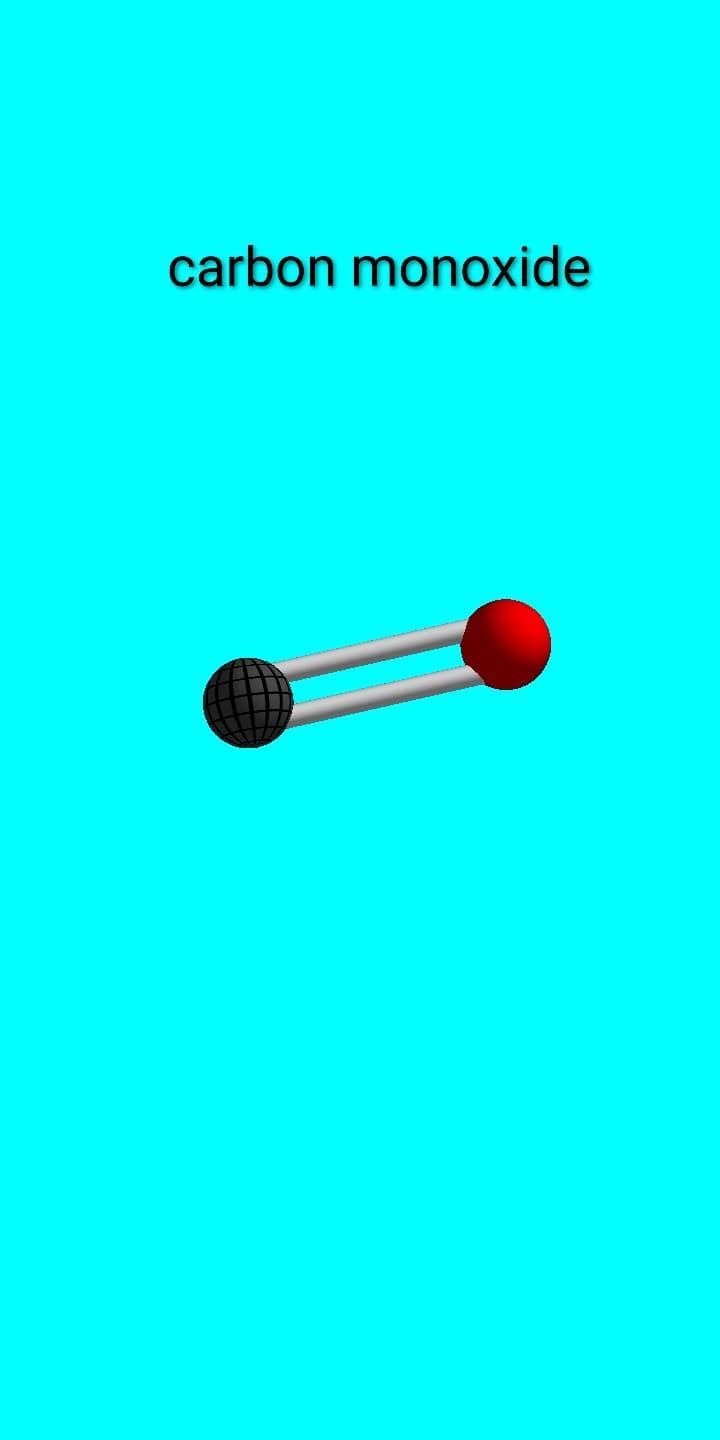
CO has 3 lone pairs of electrons and 2 bonding pairs. Out of the 2 bonding pairs, one is a σ bond and the other is a π bond. Although the π bond is weak, the σ bond is quite strong. There are two oxide compounds of C, namely:
   1. Carbon dioxide (CO 2 )
   2. Carbon monoxide (CO)


      In CO, the percentage of C is 42.86% and the percentage of O 2   is 57.14%, difference: 14.28%
On the other hand, in CO 2 , the percentage of C is 27.27% and the percentage of O 2 is 72.73%, Difference: 45.46% If we examine the two compounds, it can be seen that in each case, the amount of CO is more and the difference in carbon and oxygen between them is less. Again, since CO has one molecule each, they will need less space to form bonds and they can be stuck to each other with only one pi and sigma bond.
On the other hand, C O 2 contains 1 C molecule and 2 O 2 molecules. The amount of C is less but the amount of oxygen is more. Even though the π and σ bonds are strong, it is not possible to carry or hold such a large number of oxygen molecules between them. Moreover, homologous bonds will repel each other. So when all the O 2 molecules of C O 2 come to one side of the C, the oxygen molecules start repelling each other. When C is excited, the electrons of 2P 2 are divided into 2Px, 2Py and 2Pz. In this, the 2Pz sublevel is completely empty. Later, when C is excited again, one of the 2 electrons in 2S goes to 2Pz. And this creates 4 arms or bonds of C. C(6)\*\* → 1S2 2S1 2px¹ 2py¹ 2pz1

```plaintext
		  |
		— C —
		  |
When there were two bonds in C, some oxygen molecules (1 out of 2) took their place and repelled the other molecules. C + = O - O – O - C + = O -
The second molecule excites the carbon further. This creates two more bonds of C, i.e. σ and π bonds. The second oxygen molecule takes its place in that bond.
O - = C + = O -
On the other hand, since the 2 pi bonds and 2 sigma bonds are almost side by side, a repulsive force starts working between them. So the C and the 2 oxygen molecules stay away from each other.
		 O = C = O
By moving away, it is meant that the bonds move away due to the repulsion between the two. In this, oxygen and carbon move away from O. In this, the density of C and O 2  molecules decreases. And if the density of the molecules decreases, the boiling point and melting point decrease.
Melting point of CO 2 : 78.5°C Boiling point: 56.6°C
O = C = O
The melting point and boiling point of CO 2 are lower than that of CO. This is because there is no one to repel CO. Everyone is opposite. So, everyone attracts everyone else. Since the molecules of CO are close together, its melting point and boiling point are also high,
                                                 Melting point of CO: 205° c
			Bolling point :  191.5° c
Analyzing all the above data, it can be seen that CO 2 uses four combinations mainly due to the repulsive force.